
Beyond ‘I Like It’: How Regional Art Guilds Run Meaningful Peer Critiques
Why Community Art Feedback Often Falls Flat
In a regional art guild, critique night can begin with good intentions and still produce very little useful guidance. A painting is placed beneath the studio lights, a photograph is projected onto the wall, or a sculpture is passed carefully around the room. Then come the familiar responses: “I like it,” “That is beautiful,” or, at the other extreme, a stream of technical judgments that sounds more like an academic examination than a conversation among neighbors and fellow makers. Vague praise may feel kind, but it gives the artist no clear sense of what is working. Harsh or overly authoritative criticism can be just as limiting, especially when it makes experimentation feel unsafe.
Sharing unfinished work requires real vulnerability. A regional guild often brings together experienced exhibitors, returning hobbyists, students, and artists still finding a visual language. Each person arrives with different training, references, and levels of confidence. A work in progress may contain an unresolved passage deliberately left open, an unfamiliar material, or a subject connected to personal memory. For that reason, grassroots creative groups need a framework that is both structured and humane. The goal is not to eliminate disagreement, but to make feedback specific enough to support artistic growth while preserving the maker”s authority over the work. Learning how grassroots guilds cultivate artist confidence through structured peer dialogue can help a local group establish that balance.
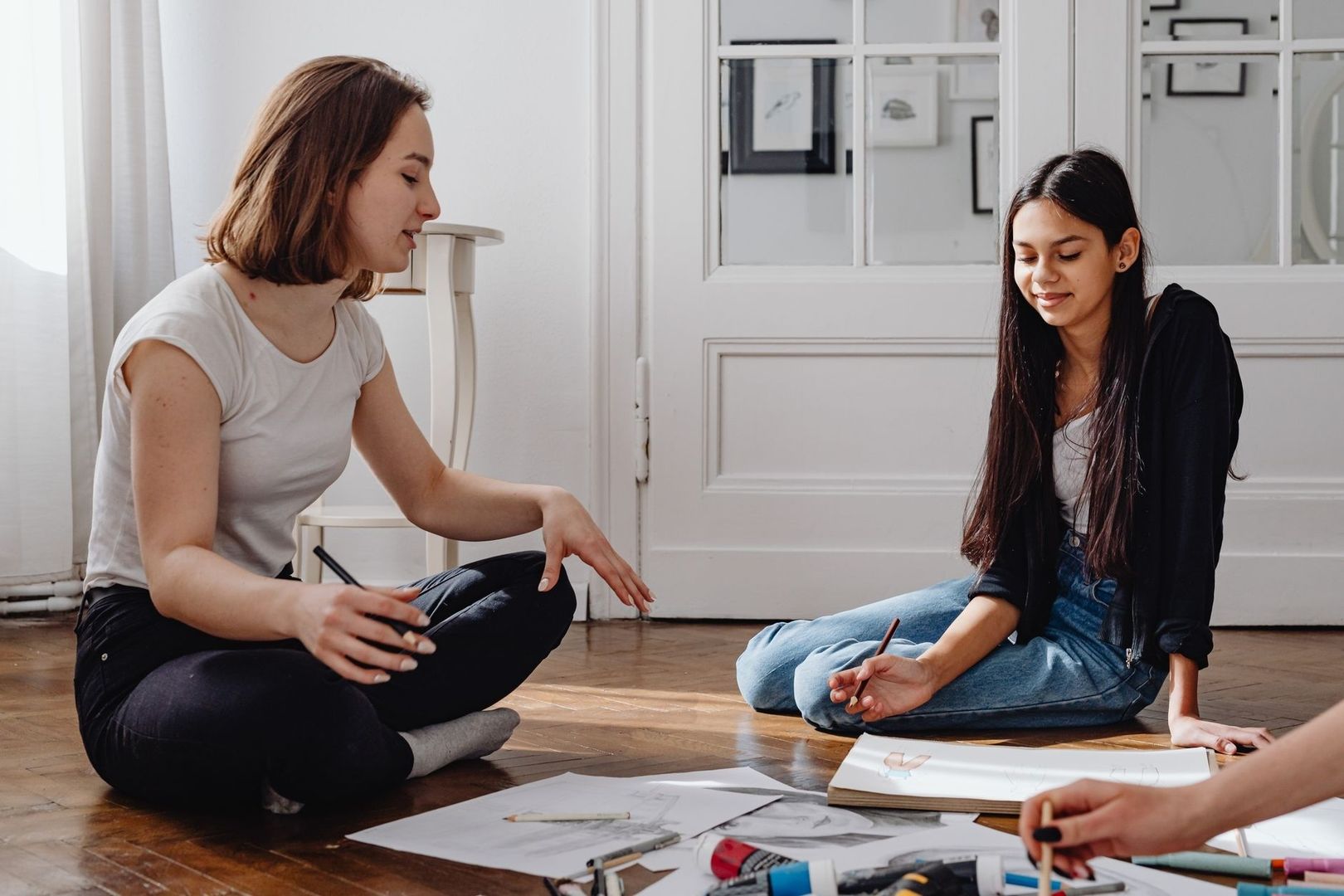
The Shift from Taste to Descriptive Inquiry
The most important change in a productive critique is the movement from personal taste toward careful observation. “I like it” describes a reaction, but it does not explain the experience that produced it. A more useful response might identify the way a narrow band of blue guides the eye across a landscape, how an unexpected empty space creates tension, or how a repeated shape establishes rhythm. These observations do not pretend to be objective in every sense, yet they give the artist something concrete to consider.
Questions such as “What do you notice first?” or “Where does your eye travel next?” help neutralize defensiveness because they ask viewers to report their experience rather than issue a verdict. The artist is not immediately told what must be corrected. Instead, the group examines how formal decisions are affecting attention, mood, clarity, and meaning. This distinction is especially valuable when a maker”s intention and a viewer”s experience do not fully align. The difference becomes information for reflection, not evidence that either side has failed.
| Preference-based response | Descriptive inquiry |
|---|---|
| “The colors are not my style.” | “The muted reds hold attention in the center, while the gray edges make the scene feel distant.” |
| “The composition feels wrong.” | “The large shape at the left carries more visual weight than the figures on the right.” |
| “I would add more detail.” | “The simplified background makes the face readable, while the lower section feels less resolved.” |
| “This reminds me of another artist.” | “The repeated vertical marks and compressed space create an effect associated with architectural drawing.” |
The Liz Lerman Critical Response Process provides a particularly useful model because it treats genuine viewer response as valuable without turning every response into a command. In a guild setting, members can practice replacing “You should” with “I noticed,” “I wondered,” and “The effect on me was.” Such language does not make critique timid. It makes the conversation more precise, allowing artists to decide which observations belong in the next stage of the work and which do not.
Adopting the Four Steps of the Liz Lerman Method
The Liz Lerman method was developed for works in progress and is designed to keep the maker actively involved in the conversation. Its sequence matters. Statements of meaning come before questions, questions come before opinions, and opinions are offered only when the artist gives permission. This order prevents the group from rushing toward solutions before understanding what the work is attempting to do.
- Begin with meaning and impact. Responders identify what they found meaningful, evocative, surprising, compelling, or exciting. Comments should remain specific. Rather than saying “This is strong,” a member might explain that the contrast between a delicate foreground and a rough, heavily worked surface creates emotional tension.
- Let the artist ask questions. The maker may ask, “Was the focal point clear?” “How did the scale affect your reading?” or “Did the repeated marks suggest movement?” These questions focus the group”s attention and ensure that feedback addresses the concerns most relevant to the current stage of the work.
- Invite neutral questions from responders. Group members can ask about intention, process, sequence, material, or visual information, but the questions should not contain hidden instructions. “What role does the unpainted section play?” is more open than “Why did you leave that section unfinished?” The artist may answer, decline, or simply consider the question.
- Share opinions only with permission. If the maker wants recommendations, the facilitator asks whether opinions are welcome. A responder might say, “Would you like an idea about the lower edge?” The artist remains free to accept, adapt, or reject it. This final step protects creative agency while still allowing practical exchange.
The sequence is effective because it separates observation from prescription. A responder may have extensive professional experience, but expertise does not automatically make every suggestion appropriate for a particular artwork. The method recognizes that the artist understands the work”s purpose, history, and constraints in ways no outside viewer can fully know. It also helps newer artists participate without feeling that critique is controlled only by the most established voices.
For guild leaders, the process offers a repeatable structure that can be introduced across painting, drawing, photography, fiber, ceramics, printmaking, and mixed media. The same framework can serve an individual consultation or a circle of ten artists. The published explanation of the Lerman method emphasizes that the approach can work across genres and in both group and one-to-one settings. A facilitator may also invite artists to name one possible next step after the discussion, without requiring a public defense of every decision.
Facilitation Tactics for Building Brave Creative Spaces
A comfortable room is not automatically a brave creative space. Comfort can mean that difficult observations are avoided, while bravery means participants can examine uncertainty and difference without humiliation. At the same time, bravery must never be used as an excuse for discrimination, ridicule, or personal attack. Community arts educators should establish genuine protection from harassment while also making room for thoughtful artistic disagreement. Research and practice around creative expression consistently place agency at the center of participation, because artists need meaningful control over their words, choices, and creative direction. The distinction between comfort and constructive risk is explored in discussions of brave spaces and safe spaces.
The guild leader serves as timekeeper, host, and conversational referee. That role is not about controlling interpretation. It is about protecting the conditions in which interpretation can happen. Before the first artwork is presented, the facilitator should explain the sequence, model descriptive language, and clarify that the artist may pause or redirect the discussion. During the session, the facilitator can interrupt a recommendation that arrives too early, ask a speaker to offer evidence from the work, or invite a quieter participant to contribute without putting that person on display.
- Use a visible speaking order so no single voice dominates the room.
- Ask frequent contributors to listen for one round before speaking again.
- Invite written observations before open discussion, giving reflective members time to form responses.
- Pair technical comments with questions about effect, intention, or viewer experience.
- Correct dismissive language immediately, especially comments about identity, background, ability, or artistic legitimacy.
- Offer several ways to participate, including speaking, writing, pointing to a detail, or responding through a small-group conversation.
Practical Protocols for Guild Meeting Nights
A successful critique begins before the artwork enters the room. The meeting notice should explain that members may bring finished work, unfinished work, or a focused problem from the studio. Artists should identify what kind of response they want, such as help reading the focal point, feedback on sequence, or observations about material handling. This small amount of preparation prevents a group from treating every artwork as though it were seeking the same kind of evaluation.
A ten to fifteen minute review per piece is long enough for meaningful exchange without exhausting the group. A practical evening template might allow two minutes for the artist to introduce the work and name a question, three minutes for statements of meaning, three minutes for artist-led questions, four minutes for responder questions, and two minutes for permission-based opinions or next steps. A larger work or complex installation may require more time, while a quick study may benefit from a shorter round. Organizations such as the Association for Visual Arts demonstrate how critique groups, artist talks, workshops, exhibitions, and member gatherings can function together as part of a wider regional arts ecosystem.
- Open with a brief reminder of the process and the right to pass.
- Display one work at a time and reduce side conversations.
- Keep the artist listening during the first response round unless clarification is needed.
- Record recurring observations when the artist requests written notes.
- End each critique with the artist naming one insight, question, or possible studio experiment.
- Reserve five to ten minutes at the end of the meeting for voluntary reflection and goal setting.
Post-critique reflection should remain voluntary and practical. An artist might decide to test a different crop, make a small color study, alter the lighting, or leave the work unchanged after considering the group”s responses. The facilitator can invite members to write a private studio goal for the following week, then revisit those goals at a later meeting if participants wish. This turns critique from a single evening of commentary into an ongoing learning rhythm, while respecting the fact that not every suggestion should become an assignment.
Transform Your Guild Into an Engine of Growth
Descriptive inquiry works best when it becomes a shared ritual rather than a special technique used only by advanced members. Over time, artists learn to distinguish observation from preference, curiosity from correction, and useful challenge from personal judgment. The group develops a common vocabulary for discussing edges, rhythm, scale, contrast, sequence, surface, atmosphere, and emotional effect. That vocabulary strengthens both individual practice and the guild”s wider cultural life.
A full program does not need to launch all at once. A guild leader can begin with a small pilot session involving three or four artists, explain the four steps, and collect brief feedback afterward. If the pilot feels productive, the format can expand to monthly review circles, workshop follow-ups, or exhibition preparation sessions. With consistency, a regional guild becomes more than a place to display finished work. It becomes a generous engine of growth, where emerging artists gain confidence, experienced artists continue learning, and creative neighbors remain connected through the ongoing work of looking carefully together.
